Pathophysiology
Unlike in 1st degree block, not all of the impulses from the sino-atrial node will be able to conduct through to the ventricles. Some of the p-waves will be blocked, leading to dropped (missing) QRS complexes within the trace.
We need to further subdivide second degree heart blocks into Mobitz type I and Mobitz type II patterns, because the clinical implication of each pattern is very different
Mobitz Type 1 Heart Block
Mobitz type I heart block occurs where there is a progressive increase in PR length, before eventually one p-wave is not conducted through to the ventricles. This is known as Wenkebach phenomenon. The pattern will then reset before repeating itself.
Mobitz type I is usually a benign condition, and rarely results in any clinical symptoms. It can be physiological e.g. occurring at periods of rapid heart rates, or sometimes is caused by medications such as beta blockers and digoxin.

The trace above is split into a repeating pattern. Look at the animation below which focusses on the first part of the pattern. Notice how the PR interval increases until one QRS complex is dropped
ECG findings
-
Increasing PR interval (Wenkebach phenomenon)
-
Dropping of QRS complex

Mobitz Type II Heart Block
Mobitz type II heart block is a serious arrhythmia in comparison to Mobitz type 1. It is very unstable, and often will progress to asystole or complete heart block. Mobitz type II reflects diffuse disease of the AV node and His-purkinje system. QRS complexes will often be dropped, but there will not always be a fixed ratio of p-waves to QRS complexes before one is dropped.
The PR interval in Mobitz type II is of a fixed duration, there is no Wenkebach phenomenon.


Look at the animation below to see where the dropped beats are occurring. Notice how the PR interval stays constant, then one QRS complex is dropped periodically
ECG findings
-
Constant PR interval
-
Dropping of QRS complexes
-
QRS complex slightly broader suggesting diffuse conducting system disease
What is 2:1 Heart Block
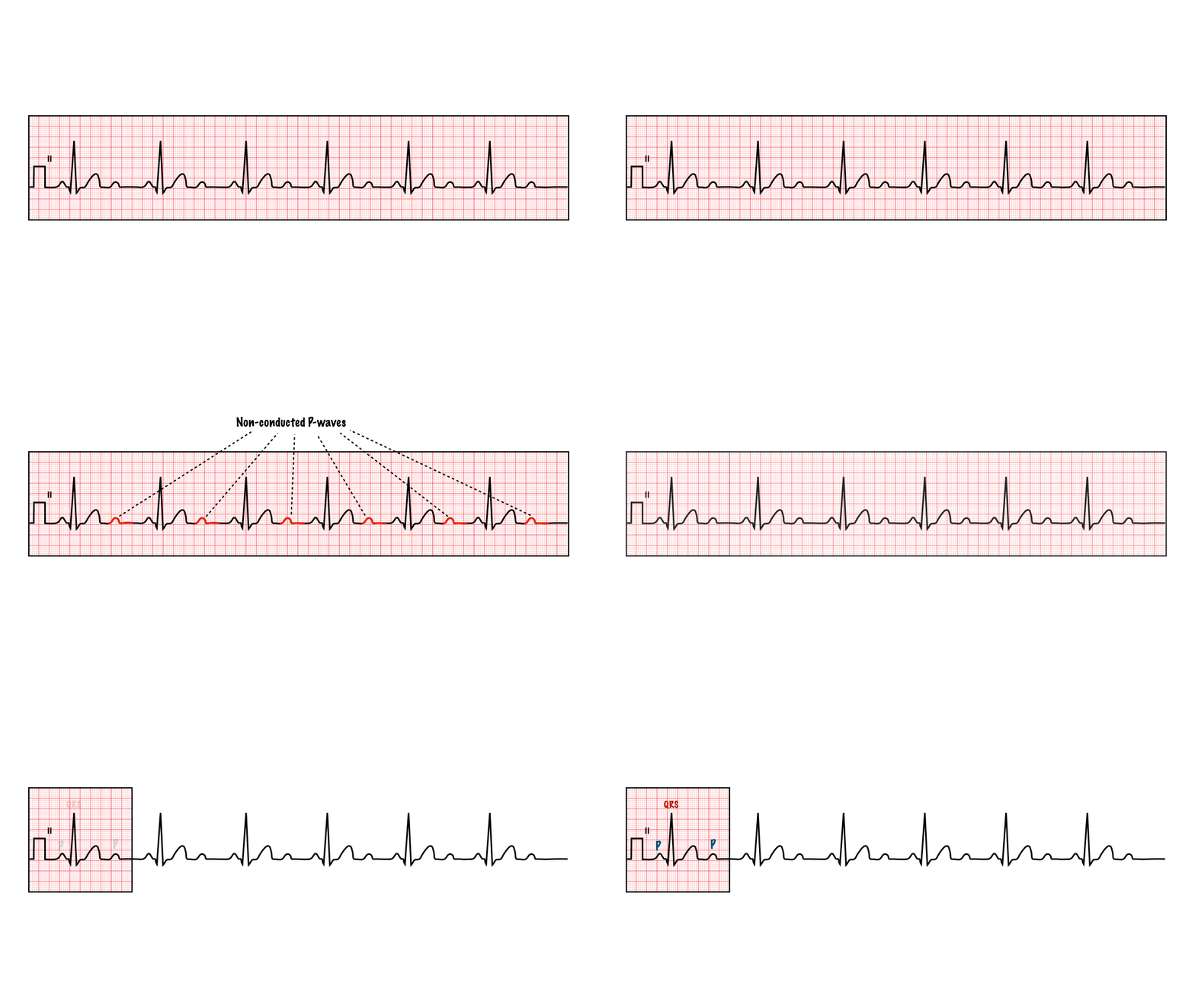
2:1 heart block is a specific type of second-degree atrioventricular (AV) block characterized by the conduction of only every other atrial impulse to the ventricles. In this condition, for every two atrial impulses, only one is transmitted to the ventricles, resulting in a ventricular rate that is half that of the atrial rate.
As every second P-wave is not conducted to a QRS complex we can't say whether this is a Mobitz type I pattern or a type II pattern

While all second-degree AV blocks involve some impairment in the conduction between the atria and ventricles, the patterns and clinical implications of each type can vary significantly. Understanding these differences is crucial for proper diagnosis and management. You can see from the animation below how 2:1 heart block appears on the ECG as a repeating pattern,